OUR LEGACY
Centuries of Stories.
One Living Estate.
Cnoc Cais (Ash Hill)
[ knok kosh ] • proper noun, Irish
1. Literal translation: The Hill of Cais.
2. The ancient, recognized placename for the land upon which Ash Hill stands, first recorded in the 16th century by the Diocese of Limerick.
Ash Hill is more than a Georgian home. It is a living archive of Irish history, deeply rooted in the ancient landscape of County Limerick. From prehistoric origins and 18th century artistry to revolutionary times and family guardianship, discover the chapters that have shaped these lands.
Timeline
4000 B.C. – 1000 A.D.
Sacred Earth & Prehistoric Discoveries
Ancient Roots
Long before the first stones of the house were laid, these grounds held sacred significance. The oldest evidence of human presence is a long barrow grave dating between 4000 and 2000 B.C., vividly described in historic letters written by Eileen Foster during her 1908 visit to her ancestral home. She recounted a large green mound near the avenue, believed to be the burial site of an ancient Irish chieftain and his followers. Local reverence and folklore ran so deep that not a single man could be found who would put a spade into the sacred earth, leaving the monument untouched through time.
Beside the site of an ancient lake lay the remains of a crannog, a traditional timber island dwelling dating prior to 1000 A.D. When the lake was drained in 1915, the land revealed extraordinary preserved remains of the giant Irish Elk from the interglacial period, linking Ash Hill directly to Ireland's primeval past.


Photo of Castle Coote remains
Photo of Ash Hill from the Lawerance collection
1667 -1781
The Coote Era & Georgian Craftsmanship
Georgian Splendor
The documented lineage of Ash Hill begins in 1667 when Chidley Coote acquired the property from Catherine Bligh. On these grounds stood Castle Coote, the birthplace of Lieutenant General Sir Eyre Coote in 1726. He would become one of the premier military tacticians of the eighteenth century, famously winning India during the Seven Years War and achieving legendary victories despite being outnumbered nearly twenty to one.
Though Castle Coote was demolished in the latter half of the eighteenth century, the estate evolved gracefully. Between 1720 and 1740, the magnificent courtyard was constructed, followed by the main Georgian house built by Chidley Coote in 1781 overlooking the cobblestones. Many windows looking onto this courtyard still retain their original 18th century glass.
Inside, this golden era produced plasterwork of exceptional architectural importance. Magnificent ceilings display intricate stucco medallions of female dancers from Herculaneum and Hercules, echoing the master craftsmanship found in Ireland's most grand historic estates.


The ceiling is a fine example of decorative plasterwork, incorporating medallions of the female dancers from Herculanium as well as one medallion of Hercules.


The courtyard to the main house was built sometime between 1720 and 1740 and it was restored in the 1950's by the late Mrs. Denny Johnson.
1830s – 1920s
Gothic Transformations & Revolutionary History
Turmoil & Transformation
In the 1830s, Eyre Evans commissioned the architect Charles Anderson to redesign the front of the house in a dramatic Gothic Revival style, crowning the estate with two majestic castellated towers. However, due to excessive property valuation rates in the early 1960s, parts of the house, including these grand towers, were carefully removed, revealing the balanced Georgian silhouette seen today.
During the turbulent times of the Irish War of Independence, Ash Hill was occupied by three successive sets of troops. The house was looted and vandalized, with soldiers using ancient family portraits for target practice and scattering the historic library underfoot. To this day, the top floor rooms hold a poignant piece of living history, where walls still display original pencil sketches and graffiti left by occupying troops and prisoners.
As these revolutionary times drew to a close, legendary Irish leader Michael Collins visited Ash Hill on his journey south, shortly before his untimely death. Throughout these changing eras, descendants from around the globe, including Eileen Foster in 1908, returned to visit their ancestral home, capturing the enduring magic of the estate in letters and memories.


There is a considerable amount of graffiti left on the walls of the top floor rooms which were occupied by both troops and prisoners.
George and Stanley Evans in 1912 or 1913
Eyre Evans aged 18 in 1791
1946 – Present
The Johnson Family Stewardship
A New Chapter & Equestrian Legacy
A vibrant new chapter opened in 1946 when Mrs. Denise Johnson acquired Ash Hill. A fearless and accomplished equestrian, Denise ran a highly successful stud on the grounds and celebrated over fifty point to point victories. After numerous falls, her doctor famously advised her to take up a safer sport. Embracing the challenge, she transitioned to 3-day eventing and went on to proudly represent Ireland at an international level.
In 1956, she married Stado Johnson, and together they lovingly restored the historic courtyard to its original splendor.


Colonel Stado Johnson
Mrs. Denise Johnson - Point-point-rider
Today at Ash Hill
Simon & Nicole Johnson
A Living Home
Today, the story of Ash Hill continues with warmth, care, and authentic hospitality. Simon and Nicole are delighted to welcome guests into their historic home, preserving the character of the estate while creating a peaceful sanctuary for travelers from all around the world.
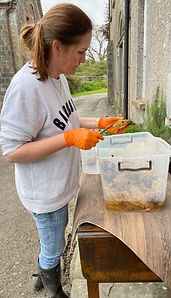
Deeply connected to the land, their personal passions shape the everyday experience at Ash Hill. From tending to the kitchen garden and caring for their thriving apiary to preserving the surrounding natural wildlife, nature is woven into everything they do. Guests are invited to share in these gentle rhythms, whether tasting fresh honey at breakfast or simply enjoying the quiet beauty of the grounds.
To learn more about estate life, our garden, and the unique activities you can enjoy during your stay, explore our Experiences section on the Local Guide page.